HP
####
This time i decided to write about two very famous portuguese dessert pastries worldwide, Portuguese egg tarts ( Pastéis de Nata, also known as Pastéis de Belém ) and Queijadinhas ( or queijadas ). Honeyzita, if you remember the later is the pastry i wanted you to try but unfortunately, most houses in Portugal only sell packs of 6 queijadinhas.
In Lisbon, you cannot walk one block without hearing thousands of sweet little voices calling your name from
pastelaria windows, teasing you with promises of puff pastry, custard fillings, orange flower water, almonds and nuts, fruits and chocolate, crispy crusts and spongy dough.
QUEIJADAS DE SINTRA:
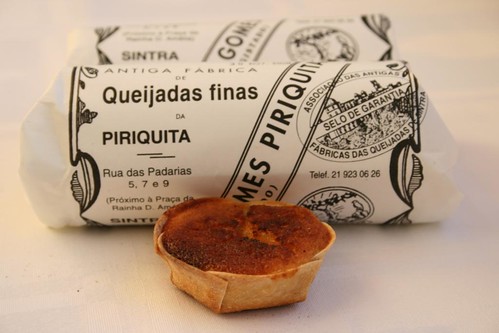
Just northwest of Lisbon, in the beautiful mountain town of Sintra, you will find Queijadas. Like their name, these little egg pastries are made with fresh cheese (queijo fresco). Queijadas start with a thin and flaky crust, which is then filled with a mixture of flour, sugar, egg yolk, fresh cheese (unsalted) and cinnamon. There are several varieties of Queijadas around the area, which differ only slightly. However, there is one Pasteleria which has gained considerable fame for its innovative and unique Queijadas.
Queijadas de Oeiras, located in the town of Oeiras, makes a wide variety of Queijadas, but has gained a reputation for its Queijada stuffed with nuts, coconut, corn and chick pea! There are Queijadas also made with marzipan from
Mafra called,
Fradinhos. Yet despite the unique variations, Queijadas de Sintra appears to be the local favorite. And having tried the other two, I wholeheartedly agree that these particular Queijadas stand apart from the rest.
It is said that the strong cinnamon taste in it, is a reflection of Portugal's moorish past.
Ingredients
Dough:
120g plain flour
60ml water
large pinch salt
Filling:
210g ricotta or any fresh unsalted cheese
2 egg yolks (preferably from 50-55g eggs)
160g sugar
20g plain flour
pinch salt
� tsp ground cinnamon
Method
�� You need one or more standard muffin trays or individual muffin/tartlet pans. Each pan is about 7cm in diameter at the top and about 2.5cm high. The recipe also works well with pans slightly larger or smaller in diameter.
� Prepare the dough first. It can be made up to 24 hours ahead. Mix the flour, water and salt, and knead to a smooth, firm dough. Leave it to rest.
�� Finely mash the ricotta or push it through a sieve. Do not use a food processor. Add the egg yolks, sugar, flour, salt and cinnamon. Mix until fairly smooth.
�� Preheat the oven to 250C.
�� Grease the pans. To make the pastry cases, roll out the dough thinly on a smooth surface or use a pasta machine. Keep the surface and your rolling pin lightly floured at all times. You need sheets of dough no more than 1.5mm thick. The pans in a standard muffin tray have bases about 5.5cm in diameter, and you will need to cut circles of dough of 8.5cm diameter, to make walls about 1.5cm high. If the bases of your pans are larger or smaller, adjust the size of the circles. If the dough is soft, leave it to dry a little before cutting the circles, as this will make it easier to handle.
�� For each circle of dough, use a sharp knife to make five 1cm incisions from the edge inwards, equally spaced around the circle.
�� When you finish each circle, place it over a pan, push the centre down to form the base of the tartlet. Overlap the edges of the incisions and press them lightly against the walls of the pan. The walls of the pastry case do not have to reach the top of the pan. Try to avoid gaps at the bottom of each incision, as the filling could leak.
�� Spoon filling into each pastry case up to about 3mm below the rim.
�� Bake for 10-15 minutes, until the filling begins to turn dark-brown in places. Remove. Allow to cool briefly, remove the tartlets from their pans and transfer to a wire rack.
�� Eat at room temperature. The tartlets keep for a few days stored in an airtight container.
 PORTUGUESE EGG TARTS ( Pastel de nata ):
Pastel de nata is a small custard tart found throughout Portugal's pastry shops or cafés. It is believed that it was created before the 18th century by Catholic Monks at the Jerónimos Monastery.
Casa Pastéis de Belém in Lisbon was the first place outside the convent selling this creamy dessert, and there they are called Pastéis de Belém, after the name of the area.
It has since become available at numerous bakeries, as well as Macau-style restaurants and Hong Kong branches of the KFC restaurant chain. Portuguese-style egg tarts became popular in Singapore, Malaysia, Hong Kong and Taiwan in the late 1990s.
INGREDIENTS
PASTRY90g plain flour
45-70ml cold water
1/4 tsp salt
70g unsalted butter
METHOD
Make the puff pastry.
· When finished, roll out the pastry to a 20cm x 10cm rectangle, 1cm thick. (If using bought pastry, on a lightly floured board, fold a sheet of thawed puff pastry in thirds so you have a long, narrow strip with three layers. Press the edges together lightly with a rolling pin, then roll outwards from the centre to increase the pastry's length a little).
· Roll up into a log shape, like a Swiss roll, with the long edges forming the log's ends. The log will be 4-5cm in diameter. Cover in plastic wrap and refrigerate for 30 minutes. While it is chilling, make the custard (see next section).
· Remove the pastry from the fridge and with a sharp knife, cut 1cm thick discs from the log. Gently flatten the disc with a rolling pin to increase its diameter. Press the disc into its pan, starting in the middle of the base and, working outwards, up the sides. The pastry will be thin. Cover the pans with plastic wrap and refrigerate.
· Preheat the oven to 300C (or its maximum).
CUSTARD22g plain flour
160g sugar
3 egg yolks
1 egg
300ml milk
approx 2cm x 6cm shaving of lemon rind
pure icing sugar and ground cinnamon, for sprinkling
METHOD
· Sift flour and sugar into a bowl.
· Lightly beat together the egg yolks and whole egg.
· Put the milk and lemon rind in a saucepan and gradually bring to the boil. Remove rind.
· Pour half the boiling milk over the flour and sugar and stir until the sugar has melted and the mixture is smooth. Add this to the remaining milk in the saucepan and stir over low heat for a minute.
· Pour a few spoonfuls of the hot mixture onto the beaten egg and stir well. Then pour the egg into the flour and sugar mixture, stirring constantly until mixed.
· Remove from heat and let the custard cool for a good while.
· Put either individual muffin pans or muffin tray on to a baking sheet to catch any drips.
· Pour the custard into the pastry cases, leaving about half a centimetre below the rim of the pastry.
· Put the tray in the oven, on the top shelf, with the tarts at the back.
· Bake for 6-10 minutes. Check the tarts after six minutes. Don't be worried if the custard mushrooms a little during cooking. If the pastry edges are browning well and the custard has even a few spots of brown, then the tarts are ready. You can pop them under a griller if you want more brown spots on top, but only for 10-20 seconds.
If the pastry edges are only golden, or the custard is still runny, you will need to leave the tarts in the oven for another minute or two. It is better to have slightly undercooked pastry than to curdle the custard. Allow the tarts to cool for a few minutes before removing from the pans. Place on a rack to cool. They are at their best when just warm.

 Links :
-
http://www.leitesculinaria.com/writings/features/belem.html-
http://www.csmonitor.com/2004/0811/p11s01-trgn.html-
http://www.notquitenigella.com/2007/11/26/portuguese-custard-tarts/-
http://www.syrupandtang.com/200811/pasteis-de-nata-portuguese-custard-tarts/-
http://www.getportugal.com/




22.JPG)

 Posts
Posts

